---
title: "Absent/Thin Infundibular Stalk"
docid: "28acc91f-2d29-40b9-8a91-b02f16fe1284"
authors:
- key: "d19354f3-7ff2-495a-ad3f-064122e45602"
value: "Bernadette L. Koch, MD"
- key: "f184750a-90b4-47a7-907b-23b05d70357a"
value: "Chang Yueh Ho, MD"
- key: "5cff4116-3654-4b3a-bb75-5ebe0b8c9850"
value: "Anne G. Osborn, MD, FACR"
breadcrumbs:
-
name: "Brain"
slug: "brain"
treeNodeId: "6d8829f1-14d7-45af-8675-255189aa526a"
-
name: "Differential Diagnosis"
slug: "differential-diagnosis"
treeNodeId: "a7fdd139-664e-4bb8-8d18-400e4733ff60"
-
name: "Sella/Juxtasellar, Pineal Region"
slug: "sellajuxtasellar-pineal-region"
treeNodeId: "5e38b9c1-3137-47e3-aa83-1fc82cb4099a"
-
name: "Anatomically Based Differentials"
slug: "anatomically-based-differentials"
treeNodeId: "7a51b2ca-8fee-4c16-aff3-b7189f68ea60"
-
name: "Absent/Thin Infundibular Stalk"
slug: "absentthin-infundibular-stalk"
treeNodeId: null
category: "Brain"
cmeTopicId: "de5d172c-08db-4868-91e2-2c4c5abb46f8"
documentVersionId: "4bb611b8-7285-4280-8fd5-85245ba57fcb"
imageCount: 19
lastUpdated: "02/01/23"
pageDescription: "Absent/Thin Infundibular Stalk"
pageKeywords: "Brain, Differential Diagnosis, Sella/Juxtasellar, Pineal Region, Anatomically Based Differentials, Absent/Thin Infundibular Stalk"
pageTitle: "Absent/Thin Infundibular Stalk | STATdx"
enhancedTitle: "Absent/Thin Infundibular Stalk"
type: "DDX"
references: true
breadcrumbs:
- "Brain"
- "Differential Diagnosis"
- "Sella/Juxtasellar, Pineal Region"
- "Anatomically Based Differentials"
- "Absent/Thin Infundibular Stalk"
---
# ESSENTIAL INFORMATION
- ## Key Differential Diagnosis Issues
- Congenital or acquired
- History of trauma or sellar/suprasellar surgery
- ## Helpful Clues for Common Diagnoses
- **Pituitary Stalk Transection, Posttraumatic**
- Usually occurs following motor vehicle accident
- Can occur with closed head injury
- ± accompanying basilar skull fracture
- **Pituitary Stalk Transection,****Postsurgical**
- Children: Commonly after craniopharyngioma resection
- Adults: Commonly after macroadenoma resection
- ## Helpful Clues for Less Common Diagnoses
- **Septo-Optic Dysplasia**
- Optic nerve hypoplasia, often asymmetric
- ± absent septum pellucidum, sometimes partial
- ± ectopic posterior pituitary
- Pituitary dysfunction in most patients, even if normal-appearing pituitary
- ± polymicrogyria &/or schizencephaly
- **Holoprosencephaly**
- Failure of prosencephalon cleavage
- 70% with diabetes insipidus from hypothalamic fusion
- **Pituitary Stalk Anomalies**
- **Ectopic posterior pituitary**
- Posterior pituitary T1 "bright spot" in hypothalamus
- Rarely partial ectopia: 1 bright spot in normal location & 1 ectopic
- Stalk thin or absent, shallow sella, small pituitary
- Associated with septo-optic dysplasia
- **Duplicated stalk**
- 2 separate, thinned stalks seen on coronal view
- Associated with 2 pituitary glands and basilar arteries
- Tuber cinereum thickened, often fused with mammary bodies
- Craniofacial anomalies
- Theorized from splitting of rostral notochord during blastogenesis
- **Persistent embryonic infundibular recess**
- Proposed from failure of closure of embryonal infundibular recess
- Tubular cyst of stalk connecting 3rd ventricle and sella
- Best seen on sagittal views
- **Pituitary Stalk Interruption Syndrome**
- Pickardt-Fahlbusch syndrome
- Most likely multigenic origin and inheritance pattern
- Whole exome sequencing potential genes related to the Wnt, Notch, & sonic hedgehog signaling pathways that regulate pituitary embryogenesis
- Thin, interrupted, attenuated or absent pituitary stalk
- Aplasia or hypoplasia of anterior pituitary
- Absent or ectopic posterior pituitary
- Hormonal deficiencies except for hyperprolactinemia
- Most patients referred later in childhood for growth retardation
- Viewed as mild form of holoprosencephaly spectrum
- ## Helpful Clues for Rare Diagnoses
- **Meningitis**
- Children with group B streptococcus
- Diencephalic infarction
- Secondary atrophy of optic chiasm, pituitary stalk
- **Neurocysticercosis**
- Racemose neurocysticercosis cysts stretch infundibular stalk
## References
# Selected References
1. [Huang J et al: Noncontrast MRI protocol for selected pediatric pituitary endocrinopathies: a procedure with high diagnostic yield and potential to reduce anesthesia and gadolinium-based contrast exposure. AJNR Am J Neuroradiol. 42(10):1884-90, 2021](http://www.ncbi.nlm.nih.gov/pubmed/?term=34475192%5Bpmid%5D)
1. [Voutetakis A: Pituitary stalk interruption syndrome. Handb Clin Neurol. 181:9-27, 2021](http://www.ncbi.nlm.nih.gov/pubmed/?term=34238482%5Bpmid%5D)
1. [Brauner R et al: Pituitary stalk interruption syndrome is characterized by genetic heterogeneity. PLoS One. 15(12):e0242358, 2020](http://www.ncbi.nlm.nih.gov/pubmed/?term=33270637%5Bpmid%5D)
1. [Ybarra M et al: A new imaging entity consistent with partial ectopic posterior pituitary gland: report of six cases. Pediatr Radiol. 50(1):107-15, 2020](http://www.ncbi.nlm.nih.gov/pubmed/?term=31468085%5Bpmid%5D)
1. [Sen D et al: Duplication of the pituitary gland - plus syndrome. Indian J Radiol Imaging. 26(1):126-30, 2016](http://www.ncbi.nlm.nih.gov/pubmed/?term=27081236%5Bpmid%5D)
1. [Voutetakis A et al: Pituitary stalk interruption syndrome: cause, clinical manifestations, diagnosis, and management. Curr Opin Pediatr. 28(4):545-50, 2016](http://www.ncbi.nlm.nih.gov/pubmed/?term=27386973%5Bpmid%5D)
1. [Glastonbury CM et al: Masses and malformations of the third ventricle: normal anatomic relationships and differential diagnoses. Radiographics. 31(7):1889-905, 2011](http://www.ncbi.nlm.nih.gov/pubmed/?term=22084178%5Bpmid%5D)
1. [Reynaud R et al: Pituitary stalk interruption syndrome in 83 patients: novel HESX1 mutation and severe hormonal prognosis in malformative forms. Eur J Endocrinol. 164(4):457-65, 2011](http://www.ncbi.nlm.nih.gov/pubmed/?term=21270112%5Bpmid%5D)
1. [Steno A et al: Persisting embryonal infundibular recess. J Neurosurg 110: 359-62, 2009](http://www.ncbi.nlm.nih.gov/pubmed/?term=18950267%5Bpmid%5D)
## Images
### Selected Images
 from a transsphenoidal approach. Postsurgical changes are seen in the sphenoid sinus and nasal cavity
  .](images/app.statdx.com_image_thumbnail_6d76d6a2-d15c-46fd-a2cd-5d203ab5445f_annotated_true_size_900_quality_90_b19a5633.jpg)
**Pituitary Stalk Transection, Posttraumatic**
*Sagittal T1 C+ MR shows surgical absence of the pituitary stalk and hypothalamus from a transsphenoidal approach. Postsurgical changes are seen in the sphenoid sinus and nasal cavity .*

**Pituitary Stalk Transection, Posttraumatic**
*Sagittal T1 C+ MR shows surgical absence of the pituitary stalk and hypothalamus from a transsphenoidal approach. Postsurgical changes are seen in the sphenoid sinus and nasal cavity .*

**Septo-Optic Dysplasia**
*Coronal T2 MR shows absence of the septum pellucidum and thinning of the pituitary infundibulum . Other midline defects of septo-optic dysplasia not shown here include optic nerve hypoplasia and ectopic posterior pituitary.*

**Septo-Optic Dysplasia**
*Coronal T1 MR shows absence of the septum pellucidum and nodular T1 hyperintensity in the hypothalamus , consistent with ectopic posterior pituitary. The infundibulum is not visualized.*

**Pituitary Stalk Transection, Posttraumatic**
*Sagittal T1 C+ MR shows surgical absence of the pituitary stalk and hypothalamus from a transsphenoidal approach. Postsurgical changes are seen in the sphenoid sinus and nasal cavity .*

**Pituitary Stalk Transection, Posttraumatic**
*Sagittal T1 C+ MR shows surgical absence of the pituitary stalk and hypothalamus from a transsphenoidal approach. Postsurgical changes are seen in the sphenoid sinus and nasal cavity .*

**Septo-Optic Dysplasia**
*Coronal T2 MR shows absence of the septum pellucidum and thinning of the pituitary infundibulum . Other midline defects of septo-optic dysplasia not shown here include optic nerve hypoplasia and ectopic posterior pituitary.*

**Septo-Optic Dysplasia**
*Coronal T1 MR shows absence of the septum pellucidum and nodular T1 hyperintensity in the hypothalamus , consistent with ectopic posterior pituitary. The infundibulum is not visualized.*
 with thickening around the anterior commissure from fusion of the caudate nuclei
  in this case of semilobar holoprosencephaly.](images/app.statdx.com_image_thumbnail_346e2b4b-e78f-4ffb-9895-8fd6de44e10d_annotated_true_size_900_quality_90_6409ccec.jpg)
**Holoprosencephaly**
*Sagittal T1 MR shows ectopic posterior pituitary , absent infundibulum, and shallow sella with hypoplastic pituitary gland . Additionally, there is dysplasia of the callosal genu with thickening around the anterior commissure from fusion of the caudate nuclei in this case of semilobar holoprosencephaly.*

**Pituitary Stalk Anomalies**
*Sagittal T1 MR in a child with short stature and growth hormone deficiency shows a lack of normal posterior pituitary bright spot in the dorsal aspect of the sella. Instead, there is an ectopic posterior pituitary bright spot and absent pituitary stalk .*

**Pituitary Stalk Interruption Syndrome**
*T1 C+ MR shows a T1-hyperintense mass of the hypothalamus , which was hyperintense prior to contrast. There is a lack of normal enhancing infundibulum. Ectopic posterior pituitary and absent stalk is a potential radiographic finding for stalk interruption syndrome.*

**Pituitary Stalk Anomalies**
*Coronal T1 C+ FS MR in an 8-year-old child with multiple congenital anomalies demonstrates duplicated infundibular stalks and adenohypophyses and thickening of the hypothalamus .*

**Pituitary Stalk Anomalies**
*Axial T2 MR shows a persistent infundibular recess . There is additional cleft lip and hydrocephalus with medial atrial diverticulum .*
### Additional Images

**Pituitary Stalk Anomalies**
*Sagittal T1 MR shows enlarged CSF space communicating from a displaced 3rd ventricle into a persistent infundibular recess . Note fat within a persistent craniopharyngeal canal , cleft palate , and downward herniation of the cerebellum due to hydrocephalus from aqueductal stenosis.*

**Pituitary Stalk Anomalies**
*.Coronal T1 MR shows thinned, duplicated infundibular stalks and thickening of the tuber cinereum .*
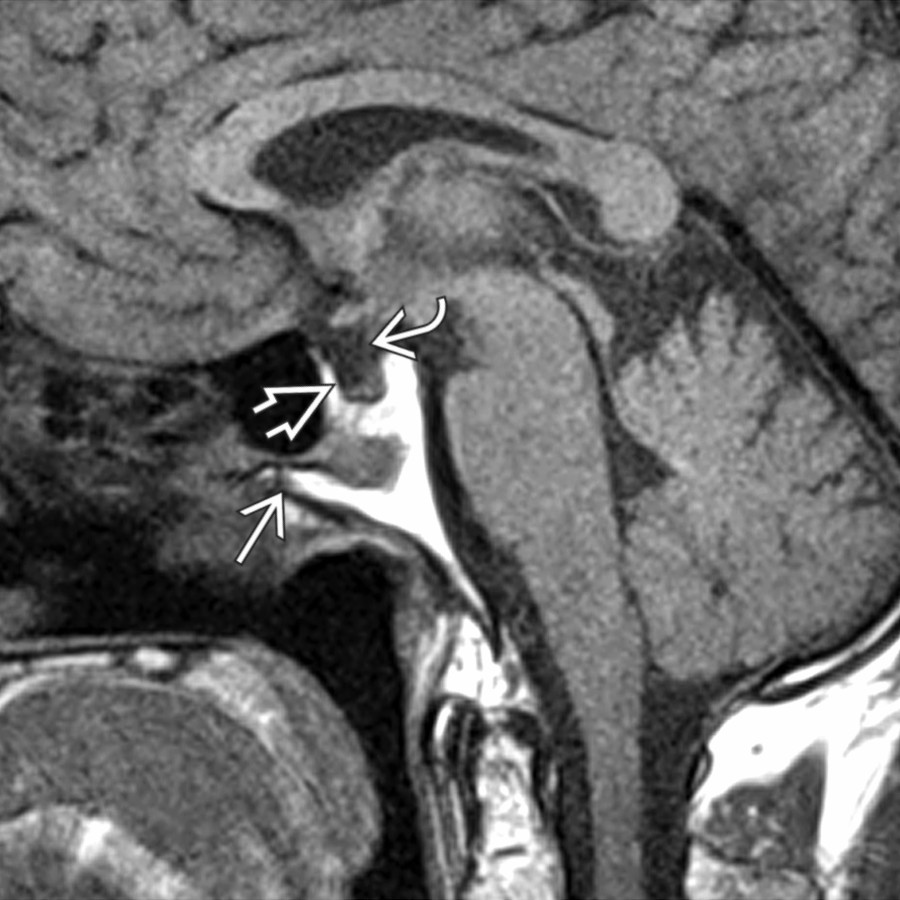
**Pituitary Stalk Transection, Posttraumatic**
*Sagittal T1 MR in a patient with hypopituitarism following transsphenoidal hypophysectomy shows an empty sella and a very thin, attenuated infundibular stalk .*

**Holoprosencephaly**
*Sagittal T1 MR shows ectopic posterior pituitary , absent infundibulum, and shallow sella with hypoplastic pituitary gland . Additionally, there is dysplasia of the callosal genu with thickening around the anterior commissure from fusion of the caudate nuclei in this case of semilobar holoprosencephaly.*

**Pituitary Stalk Anomalies**
*Sagittal T1 MR in a child with short stature and growth hormone deficiency shows a lack of normal posterior pituitary bright spot in the dorsal aspect of the sella. Instead, there is an ectopic posterior pituitary bright spot and absent pituitary stalk .*

**Pituitary Stalk Interruption Syndrome**
*T1 C+ MR shows a T1-hyperintense mass of the hypothalamus , which was hyperintense prior to contrast. There is a lack of normal enhancing infundibulum. Ectopic posterior pituitary and absent stalk is a potential radiographic finding for stalk interruption syndrome.*

**Pituitary Stalk Anomalies**
*Coronal T1 C+ FS MR in an 8-year-old child with multiple congenital anomalies demonstrates duplicated infundibular stalks and adenohypophyses and thickening of the hypothalamus .*

**Pituitary Stalk Anomalies**
*Axial T2 MR shows a persistent infundibular recess . There is additional cleft lip and hydrocephalus with medial atrial diverticulum .*
### Additional Images

**Pituitary Stalk Anomalies**
*Sagittal T1 MR shows enlarged CSF space communicating from a displaced 3rd ventricle into a persistent infundibular recess . Note fat within a persistent craniopharyngeal canal , cleft palate , and downward herniation of the cerebellum due to hydrocephalus from aqueductal stenosis.*

**Pituitary Stalk Anomalies**
*.Coronal T1 MR shows thinned, duplicated infundibular stalks and thickening of the tuber cinereum .*

**Pituitary Stalk Transection, Posttraumatic**
*Sagittal T1 MR in a patient with hypopituitarism following transsphenoidal hypophysectomy shows an empty sella and a very thin, attenuated infundibular stalk .*
 .](images/app.statdx.com_image_thumbnail_ebcdb319-d866-4c4f-af85-3b69e9c9a462_annotated_true_size_900_quality_90_4f962155.jpg)
**Pituitary Stalk Transection, Postsurgical**
*Sagittal T1 C+ FS MR following transsphenoidal hypophysectomy shows that the thinned stalk is stretched and retracted inferiorly into the partially empty sella .*

**Pituitary Stalk Transection, Posttraumatic**
*Coronal T1 MR in a child with remote head trauma who subsequently developed pituitary insufficiency shows traumatic cephalocele and absent/inapparent pituitary stalk .*

**Pituitary Stalk Transection, Postsurgical**
*Sagittal T1WI MR after transsphenoidal hypophysectomy shows a very thin infundibular stalk along with secondary empty sella .*

**Pituitary Stalk Anomalies**
*Sagittal T1 MR in a 2-year-old child with short stature and abnormally low bone age shows an absent infundibular stalk , ectopic posterior pituitary bright spot , and small pituitary gland .*

**Pituitary Stalk Anomalies**
*Coronal T1 MR shows absent stalk and ectopic posterior pituitary bright spot in the hypothalamus .*

**Pituitary Stalk Anomalies**
*Sagittal T1 MR shows 2 small-sized pituitary stalks in this case of duplicated pituitary stalks. Note abnormal configuration of posterior pituitary .*

**Pituitary Stalk Transection, Postsurgical**
*Sagittal T1 C+ FS MR following transsphenoidal hypophysectomy shows that the thinned stalk is stretched and retracted inferiorly into the partially empty sella .*

**Pituitary Stalk Transection, Posttraumatic**
*Coronal T1 MR in a child with remote head trauma who subsequently developed pituitary insufficiency shows traumatic cephalocele and absent/inapparent pituitary stalk .*

**Pituitary Stalk Transection, Postsurgical**
*Sagittal T1WI MR after transsphenoidal hypophysectomy shows a very thin infundibular stalk along with secondary empty sella .*

**Pituitary Stalk Anomalies**
*Sagittal T1 MR in a 2-year-old child with short stature and abnormally low bone age shows an absent infundibular stalk , ectopic posterior pituitary bright spot , and small pituitary gland .*

**Pituitary Stalk Anomalies**
*Coronal T1 MR shows absent stalk and ectopic posterior pituitary bright spot in the hypothalamus .*

**Pituitary Stalk Anomalies**
*Sagittal T1 MR shows 2 small-sized pituitary stalks in this case of duplicated pituitary stalks. Note abnormal configuration of posterior pituitary .*
 , inferiorly "pointed" frontal horns , and absent septum pellucidum with squared-off appearance of lateral ventricles .](images/app.statdx.com_image_thumbnail_9bcb2dfa-f9ec-45d0-9ecb-06ff59eacd45_annotated_true_size_900_quality_90_254a70d3.jpg)
**Septo-Optic Dysplasia**
*Coronal T2 MR shows classic SOD with thin stalk , inferiorly "pointed" frontal horns , and absent septum pellucidum with squared-off appearance of lateral ventricles .*

**Neurocysticercosis**
*Sagittal T1 C+ MR shows racemose neurocysticercosis cysts surrounding and stretching the infundibular stalk , extending into the sella and flattening the pituitary gland against the floor .*
, inferiorly "pointed" frontal horns , and absent septum pellucidum with squared-off appearance of lateral ventricles .](images/app.statdx.com_image_thumbnail_9bcb2dfa-f9ec-45d0-9ecb-06ff59eacd45_annotated_true_size_900_quality_90_254a70d3.jpg)
**Septo-Optic Dysplasia**
*Coronal T2 MR shows classic SOD with thin stalk , inferiorly "pointed" frontal horns , and absent septum pellucidum with squared-off appearance of lateral ventricles .*

**Neurocysticercosis**
*Sagittal T1 C+ MR shows racemose neurocysticercosis cysts surrounding and stretching the infundibular stalk , extending into the sella and flattening the pituitary gland against the floor .*